Wandering Through Flavor: A Food Lover’s Serendipitous Journey in Brunei’s Capital
You know that magic feeling when you wander without a plan and stumble upon something unforgettable? That’s exactly what happened in Bandar Seri Begawan. Far from flashy tourist traps, this quiet capital surprised me with its rich culinary soul. From sizzling street bites to hidden local eateries, every meal felt authentic and deeply satisfying. If you think Brunei is just mosques and oil wealth, think again—its food scene is a quiet revelation waiting to be tasted. In a world where travel often means checking off landmarks, Brunei offers a different rhythm: one measured in the sizzle of grills, the warmth of shared tables, and the slow unfolding of flavors passed through generations. This is not a destination for the hurried, but for those who listen with their taste buds and walk with open hearts.
The Art of Aimless Exploration in a Quiet Capital
Bandar Seri Begawan does not announce itself with fanfare. There are no towering billboards or crowded subway stations. Instead, the city unfolds gently—tree-lined avenues, well-kept sidewalks, and the quiet hum of daily life. At first glance, it may seem unremarkable to travelers accustomed to bustling metropolises. But beneath its calm surface lies a rhythm that rewards those who move slowly and observe closely. The true essence of this capital reveals itself not through grand monuments, but in the subtle details: the scent of grilled fish drifting from a roadside stall, the sound of laughter from a family gathered around a steaming pot, the sight of a vendor carefully folding banana leaves around a portion of rice.
Wandering without a fixed itinerary becomes an act of discovery. Without the pressure of ticking off attractions, the senses sharpen. A turn down an unmarked lane leads to a cluster of food carts tucked beside a neighborhood mosque. A pause at a small shop reveals shelves lined with homemade pickles and jars of golden sambal. These are not experiences found in guidebooks, but they are the ones that linger longest in memory. In Bandar Seri Begawan, the journey itself becomes the destination, and the path less traveled often leads to the most satisfying meals.
Slow travel here is not just a choice—it feels like a necessity. The city does not rush, and neither should you. This is a place where time moves with intention, where conversations unfold over long meals and traditions are honored without fanfare. For the curious traveler, this pace allows space to absorb the culture in its most authentic form. There is dignity in the quiet order of the streets, in the respectful nods exchanged between neighbors, in the care taken in preparing even the simplest dish. Brunei’s capital may be overlooked by mass tourism, but for those willing to walk without haste, it offers a rare kind of intimacy—one built on presence, patience, and the simple joy of stumbling upon something real.
Why Food Defines the Bruneian Experience
In Brunei, food is far more than sustenance—it is a language of heritage, faith, and community. The cuisine reflects a deep-rooted Malay identity, shaped by centuries of tradition and the influence of its Southeast Asian neighbors. At the same time, Islamic values play a central role in shaping what is eaten, how it is prepared, and when it is shared. Every meal carries meaning, whether it is a daily family dinner or a feast during religious celebrations. The kitchen is a place of care, where recipes are passed from mother to daughter, and where ingredients are chosen with both flavor and faith in mind.
Coconut milk forms the foundation of many Bruneian dishes, lending a rich creaminess to curries and soups. Tamarind adds a tangy depth, balancing the sweetness of palm sugar and the heat of fresh chilies. Fresh seafood, pulled from the waters of the South China Sea, appears in stews, grilled dishes, and spicy salads. Rice is the constant—served plain, fried, or wrapped in leaves—but it is the accompaniments that tell the story. Sambals, fermented condiments, and herb-laden relishes transform the ordinary into something memorable.
Communal dining is a cornerstone of Bruneian culture. Meals are rarely solitary affairs. Even in small eateries, strangers may find themselves sharing a table, exchanging smiles over shared dishes. Home-cooked food holds a special place in the heart of the culture, where hospitality is measured by how generously one feeds a guest. It is common for families to prepare extra portions, not just for relatives, but for neighbors or even passersby during festive times. This spirit of generosity extends to the way food is served—modest portions, served with care, emphasizing balance and respect for resources.
Religious observance also shapes dining habits in tangible ways. All food is halal, meaning it is prepared according to Islamic dietary laws. Alcohol is not served in public places, and meals are often timed around prayer schedules, especially during Ramadan. These practices are not restrictions, but reflections of a way of life that values mindfulness and gratitude. For the visitor, this means entering a culinary world where intention matters as much as flavor. To eat in Brunei is to participate in a tradition that honors both the body and the spirit, where every bite carries the weight of culture and the warmth of shared humanity.
Street Eats and Night Markets: Where Flavor Comes Alive
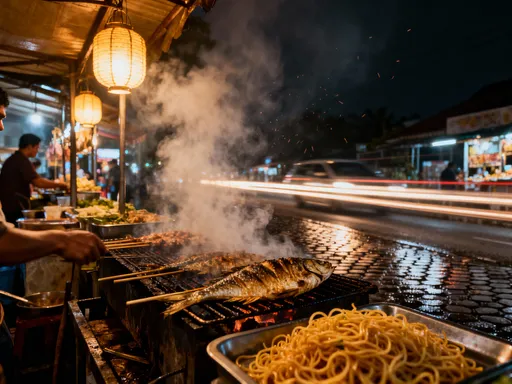
If the soul of a city can be found in its food, then the night markets of Bandar Seri Begawan are its beating heart. As the sun sets and the air cools, the streets come alive with the energy of vendors setting up their stalls. Among them, the Gadong Night Market stands out as a culinary hub, drawing locals and visitors alike with its vibrant atmosphere and irresistible aromas. This is not a polished food court, but a lively, unfiltered celebration of everyday eating. The ground is uneven, the seating is basic, and the lights are simple—but the food is extraordinary.
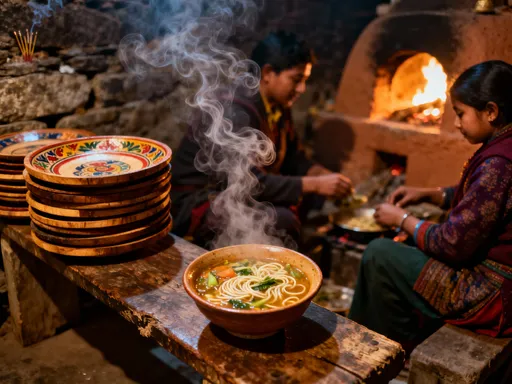
The scent of smoke and spice fills the air as grills fire up. Skewers of marinated meat sizzle over open flames, their edges caramelizing into perfect crispness. Vendors stir massive woks of fried noodles, tossing them with vegetables, eggs, and a splash of soy sauce. One of the most iconic sights is the preparation of ambuyat—a sticky, gelatinous starch made from sago, served with a side of tangy dipping sauce. Watching someone eat it for the first time is a lesson in patience: the diner twirls the soft mass around a fork, dips it into the sambal, and swallows it whole, savoring the texture more than the taste.
Another favorite is ikan bakar, or grilled fish, often wrapped in banana leaves and cooked over charcoal. The fish arrives at the table flaky and smoky, its skin charred just enough to add depth. It is typically served with a fiery sambal made from chilies, shallots, and lime, a condiment so potent it demands respect. Fried snacks like pisang goreng (banana fritters) and keropok (fish crackers) offer sweet and salty contrasts, perfect for sharing between bites of spicier dishes.
The experience is as much about the atmosphere as the food. Families gather on plastic stools, children dart between tables, and friends laugh over steaming plates. Conversations flow in Malay, English, and local dialects, creating a tapestry of voices that mirrors the diversity of the dishes. Prices remain modest, making this a true people’s cuisine—one where a full meal can be had for just a few Bruneian dollars. For the traveler, the night market is not just a place to eat, but to belong, even if only for an evening. It is here, amid the clatter of plates and the glow of lanterns, that the warmth of Bruneian hospitality shines brightest.
Hidden Eateries: Dining Like a Local
Beyond the well-known markets lie the true treasures of Bandar Seri Begawan’s food scene: the small, family-run warungs and kopitiams that thrive on reputation rather than signage. These unassuming spots often lack English menus, online reviews, or even proper addresses. They are found not through apps, but through wandering, through following the scent of spices, through noticing where the locals queue. One such place, tucked behind a row of shops near the city center, serves what many consider the best nasi katok in town—a humble dish of steamed rice, crispy fried chicken, and a spoonful of blazing sambal, served in a simple takeaway container.
Walking in, the space is basic: a few tables, a counter, and a kitchen visible behind a glass partition. The owner, a woman in her fifties with a warm smile, greets regulars by name. There is no rush, no pressure to order quickly. Instead, there is a quiet rhythm to the service, a sense that food is prepared with care, not speed. When the nasi katok arrives, it looks simple, but the first bite reveals layers of flavor—the juiciness of the chicken, the heat of the sambal, the way the rice soaks up the spices. It is not fine dining, but it is deeply satisfying in a way that only authentic, home-style cooking can be.
These interactions go beyond the meal. A shared smile, a brief conversation in broken English, a recommendation for another dish—these small moments build connection. The owner might offer a glass of cool kelapa muda, the sweet water of young coconuts served in the shell, or point to a photo of a dish not listed on the board. There is a trust here, an unspoken understanding that you are not just a customer, but a guest. This is dining stripped of pretense, where the focus is not on presentation, but on nourishment, community, and the simple pleasure of good food made with care.
For the traveler, these experiences are invaluable. They offer a glimpse into daily life, into the rhythms of a culture that values humility and generosity. In a world where dining is often curated for Instagram, these hidden eateries remind us that the most memorable meals are not always the most photographed. They are the ones shared in quiet corners, where the food is honest, the welcome is warm, and the memory lingers long after the plate is empty.
Specialty Dishes That Capture Brunei’s Essence
To understand Brunei’s culinary identity, one must try ambuyat, the national dish that defies easy description. Made from the pith of the sago palm, it arrives as a smooth, translucent gel, almost like cooked tapioca but without flavor of its own. It is eaten not with a spoon, but by twirling it around two prongs of a fork, then dipping it into a tangy, spicy sauce called cacah. The first attempt is often awkward—too much twirling, too little cohesion—but with practice, it becomes a meditative act. The texture is unique: slippery, soft, and slightly resistant, meant to be swallowed rather than chewed.
Ambuyat is more than a meal; it is a cultural ritual. Traditionally eaten during gatherings, it fosters a sense of togetherness. Families and friends sit around a central pot, sharing the same bowl, engaging in conversation as they eat. It is not fast food, nor is it meant to be. The slow, deliberate way it is consumed encourages presence, patience, and connection. For visitors, trying ambuyat is not just about tasting something new—it is about participating in a tradition that values slowness and shared experience.
Other dishes also capture the spirit of Brunei. Kolo mee, a noodle dish with roots in Chinese cuisine, has been adapted with local flavors—springy egg noodles tossed in a savory sauce, topped with char siu and green onions. It is a testament to Brunei’s multicultural influences, where immigrant traditions have been woven into the national fabric. Kelapa muda, the young coconut drink, offers refreshment in the tropical heat, its sweet water served with soft, jelly-like flesh scooped from the shell. Simple, natural, and nourishing, it reflects the Bruneian preference for foods that are both satisfying and respectful of nature’s gifts.
Each of these dishes tells a story—not just of flavor, but of history, geography, and values. They are not designed for spectacle, but for sustenance and connection. In a world that often prioritizes novelty, Brunei’s cuisine reminds us that the most meaningful meals are those rooted in tradition, shared with others, and enjoyed without haste.
Practical Tips for the Curious Food Traveler
Exploring the food scene in Bandar Seri Begawan is rewarding, but a few practical considerations can enhance the experience. First, transportation: while the city is compact, public transit is limited. Ride-hailing apps like Grab are reliable and widely used, making it easy to move between neighborhoods and night markets. Taxis are available but should be agreed upon in advance to avoid confusion over fares.
Cash is still king in most local eateries. While larger restaurants may accept cards, small warungs and market stalls operate on a cash-only basis. It is wise to carry small denominations of Bruneian dollars, as change may not always be available. ATMs are accessible in the city center, but it is best to withdraw what you need before heading to more remote areas.
Dress modestly, especially when dining in family-run establishments or visiting areas near religious sites. Lightweight, breathable clothing is ideal for the humid climate, but shoulders and knees should be covered out of respect for local customs. This small gesture goes a long way in showing cultural sensitivity and is often met with warm appreciation.
Timing matters. The midday heat can be intense, making early mornings or late afternoons the best times to explore. Night markets typically open around 5 or 6 PM and remain lively until 10 or 11. This is also when many specialty dishes are freshly prepared. If visiting during Ramadan, be mindful that many eateries may be closed during daylight hours, but the evening iftar meals offer a unique opportunity to experience communal dining at its most heartfelt.
When trying unfamiliar foods, approach with curiosity and respect. Ask vendors about ingredients if needed, and don’t hesitate to point or gesture if language is a barrier. A smile and a thank you in Malay—“Terima kasih”—can brighten someone’s day. Most importantly, be patient. Service may be slow, seating may be limited, and the menu may be unclear. These are not flaws, but part of the authentic experience. Embrace the rhythm of the place, and you will find that the journey—from discovery to first bite—is as enriching as the meal itself.
From Wandering to Wondering: A Deeper Appreciation
The most unexpected meals often lead to the most profound realizations. In Bandar Seri Begawan, the act of wandering without a plan did more than satisfy hunger—it opened a window into a culture defined by quiet pride, deep tradition, and genuine hospitality. Each unplanned stop, each shared meal, each warm exchange with a local added a layer to the understanding of what Brunei truly is. This is not a nation that seeks attention, but one that lives with intention, where values are passed down not through speeches, but through the passing of food.
Food became the bridge between stranger and neighbor, between observer and participant. In the simplicity of a nasi katok meal, in the ritual of eating ambuyat, in the laughter shared over steaming bowls at a night market, there was a sense of belonging that transcended language. These moments were not staged for tourists; they were the fabric of daily life, generously shared with those willing to slow down and listen.
For travelers, Brunei offers a powerful reminder: that the richest experiences are often found off the beaten path, in places that do not advertise, that do not rush, that do not perform. They are in the quiet corners, the unmarked doors, the tables where food is served not for profit, but for love. To visit Bandar Seri Begawan is not to check a box, but to step into a different rhythm—one where flavor, tradition, and human connection take center stage.
So let go of the itinerary. Let curiosity be your guide. Walk without destination, eat without hesitation, and trust that the best moments will find you. In a world that moves too fast, Brunei invites you to pause, to taste, to remember what travel can truly be. This quiet capital is not a stopover. It is a destination of depth, of soul, of flavor waiting to be discovered—one unhurried bite at a time.