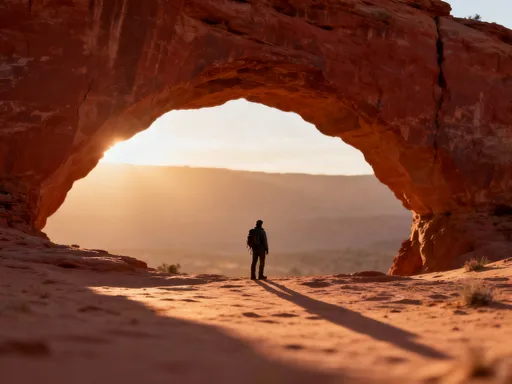
What I Found in Arches That No One Talks About
You know that feeling when you think you’ve seen it all, and then nature just drops a mic? Yeah, that was me at Arches National Park. I went for the red rocks and famous spans, but what I got was way deeper—a quiet cultural heartbeat beneath the trails. It’s not just geology out here; it’s stories carved in stone, left by people who knew this land long before park rangers or trail maps existed. This is exploration with soul. The wind doesn’t just erode sandstone—it carries echoes. And if you walk slowly enough, you might just hear them.
First Impressions: Walking Into a Red Rock Dream
As the sun rises over the Windows Section of Arches National Park, the landscape ignites in a blaze of crimson and gold. The sheer scale of the formations—massive sandstone sentinels standing against an endless sky—leaves even seasoned travelers speechless. The air is crisp, the silence profound, broken only by the occasional whisper of wind through narrow canyons. Visitors gather at viewpoints to capture the North Window and South Window arches, their symmetrical frames perfectly aligned against the morning light. Nearby, Turret Arch rises with quiet dignity, its smooth curves glowing like embers. These are the icons, the ones splashed across calendars and hiking brochures, and they live up to every expectation.
Yet, as breathtaking as these sights are, they represent only part of the story. Many arrive focused solely on photography, timing their steps to catch golden hour or avoid the midday glare. While the visual drama is undeniable, this lens-focused approach often overlooks the deeper narrative embedded in the soil and stone. Beneath the well-trodden paths and designated overlooks lies a history far older than the park’s 1929 designation. The red rocks are not just geological marvels—they are witnesses to human presence stretching back thousands of years. And though no signs shout this truth from the main trails, it is there, waiting to be noticed by those willing to look beyond the frame of their camera.
The initial awe that greets visitors is real and powerful. There’s something humbling about standing beneath a natural arch that has endured for millennia, shaped by wind, water, and time. But that awe can deepen when paired with awareness. When you realize that others stood in this very spot not just to marvel, but to live, to gather, to worship—your experience shifts. The landscape becomes more than a backdrop; it becomes a living archive. And the journey, no longer just about capturing beauty, transforms into one of connection and reverence.
Beyond the Postcard: Why Arches Is More Than a Pretty Face
Arches National Park is often celebrated for its geology—the largest concentration of natural stone arches in the world, with over 2,000 documented formations. Landscape Arch, stretching nearly 300 feet across, defies belief. Delicate Arch, perched like a sentinel above the basin, has become an emblem of Utah itself. These wonders are the result of millions of years of erosion, salt bed movement, and the slow sculpting of Entrada sandstone. But while science explains how these arches formed, it doesn’t capture why they matter on a human level.
Beneath the surface of this red rock theater, a cultural layer runs deep. Long before Ancestral Puebloans and Ute tribes left their mark, people navigated this harsh yet generous landscape with profound understanding. They gathered medicinal plants, followed seasonal water sources, and inscribed symbols into the rock faces—petroglyphs that still whisper across time. These were not random markings but deliberate communications, possibly spiritual records or territorial signs. The land was not just used; it was known, respected, and sustained across generations.
Today’s visitors, eager for summit selfies and perfect light, often miss this dimension. The park’s popularity means trails like the one to Delicate Arch can feel more like a pilgrimage of photographers than a journey of discovery. People rush to the top, snap their photos, and descend, rarely pausing to consider who might have stood there before them. A cairn of stones, a faint path off the main trail, a shadowed alcove with faded carvings—these quiet clues are easy to overlook when the goal is the view, not the context.
Yet understanding Arches as both a geological and cultural landscape enriches every step. It invites a slower, more thoughtful way of moving through space. When you recognize that the same sunlight illuminating your camera screen once fell on the hands of someone carving a spiral into stone centuries ago, the moment gains weight. This is not about romanticizing the past, but about acknowledging continuity—the thread that connects us to those who came before, even if we never know their names.
Following the Hidden Trails: Where Culture Meets Terrain
Just beyond the main parking lot near the park’s visitor center lies the Wolfe Ranch, a modest 19th-century cabin tucked into a rocky fold of the terrain. Few linger here, drawn instead to the more dramatic vistas, but those who do stop often notice something else: a rock face etched with ancient petroglyphs. These carvings, made with stone tools against the dark desert varnish, depict abstract shapes, human figures, and animals. They are fragile, weathered by time, yet undeniably present. This site is one of the most accessible windows into the human history of Arches, and yet it’s often passed by in silence.
Other traces are subtler. Near the overlook for the Fiery Furnace—a maze of narrow canyons and towering fins—evidence of ancient footpaths can still be seen. These are not official trails, but faint impressions in the earth, worn down by repeated use over generations. They don’t lead to a famous arch or a panoramic view by modern standards, but they suggest purpose. Perhaps they were routes to water, to shelter, or to ceremonial sites now lost to time. Walking near them, even without stepping on them, feels different. There’s a sense of walking alongside ghosts, of being a guest in a story that began long before you arrived.
Exploring these quieter corners requires a shift in mindset. It’s no longer about checking landmarks off a list, but about tuning into the landscape’s quieter frequencies. The terrain itself begins to feel like a text, readable if you slow down. A cluster of stones arranged in a circle. A rock shelter with faint soot stains on the ceiling. A trail that seems to avoid certain areas, as if out of respect. These are not just remnants—they are invitations. They ask you to wonder, to imagine, to listen.
And listening, in this context, is a form of respect. It means resisting the urge to touch the petroglyphs, to scramble off-trail for a better angle, or to leave your own mark in the form of graffiti or cairns. It means understanding that some places are not meant to be conquered, but honored. When you move through Arches with this awareness, the act of hiking becomes something more—it becomes a form of dialogue with the past.
The Silence That Speaks: Understanding Sacred Space
Some places in Arches feel different. Not just beautiful, not just impressive, but charged with a kind of stillness that makes you lower your voice without thinking. Double Arch, where two massive spans rise side by side like the ribs of a great beast, is one such place. Landscape Arch, so thin and elongated it seems to defy gravity, is another. These formations don’t just inspire awe—they evoke a sense of presence, as if the land itself is aware.
While the National Park Service does not officially designate any sites within Arches as ceremonial or sacred, the alignment, isolation, and symbolic power of certain formations strongly suggest that they held spiritual significance for Indigenous peoples. Spirals, concentric circles, and anthropomorphic figures in petroglyphs often appear near such sites, reinforcing the idea that these were not just scenic overlooks but places of meaning. The Ancestral Puebloans, who lived in the region from approximately 500 to 1300 CE, are known to have integrated landscape features into their cosmology. The Ute people, whose descendants still live in the region, have oral traditions that speak of the land as alive, inhabited by spirits and ancestors.
This understanding transforms how one moves through the park. Visiting these places is not merely a physical act, but an ethical one. It requires a conscious choice to be present, not performative. Sitting quietly beneath an arch at dawn, watching the light change, becomes an act of witness rather than consumption. You are not taking something from the place; you are receiving something from it.
The concept of sacred space is not exclusive to any one culture or religion. It is a universal human recognition that some places hold more than scenic value—they hold memory, energy, and meaning. In Arches, this sacredness is not announced with signs or structures. It is felt. And feeling it requires stillness, humility, and a willingness to be open. When you approach the land this way, you stop being a spectator and start being a participant in a much longer story.
How to Explore with Respect: A Practical Mindset Shift
Respect in the wilderness is not just an attitude—it’s a set of actions. In a place as fragile as Arches, where a single footprint off-trail can take decades to heal, every choice matters. The most important rule is simple: leave no trace. This means staying on designated trails, packing out all trash, and avoiding any contact with rock art. Touching petroglyphs, even with clean hands, accelerates their erosion. The oils from human skin can darken the stone and make the carvings harder to see over time. What might feel like a harmless gesture—a hand on ancient rock—can have lasting consequences.
Equally important is learning before you go. The park’s visitor center offers brochures, maps, and ranger-led talks that include information about the Indigenous peoples connected to the land. These resources are not add-ons; they are essential tools for responsible visitation. Understanding that the Ute, Paiute, Navajo, and Hopi nations all have historical and cultural ties to this region changes how you see it. It moves the landscape from a neutral backdrop to a living, storied place.
Another practical step is to avoid building cairns—stacks of stones—unless they are part of official trail markers. While some hikers create them as markers or tributes, unauthorized cairns can confuse navigation and disrupt cultural sites. In many Indigenous traditions, stone arrangements have specific ceremonial purposes, and random stacking can be seen as disrespectful. If you see a cairn that doesn’t belong, consider gently dismantling it and returning the stones to their natural state.
Photography, while a natural impulse, also requires mindfulness. Instead of framing every shot for social media, try pausing first. Sit. Breathe. Let the place settle into you before you try to capture it. Ask yourself: am I here to see, or to be seen seeing? True connection comes not from the number of photos taken, but from the depth of attention given. When you shift from documentation to presence, your experience becomes richer, and the land remains undisturbed.
The Modern Encounter: Balancing Crowds and Connection
There’s no denying that Arches is popular. With over 1.5 million visitors annually, many of its most famous trails can feel crowded, especially during peak seasons. The trail to Delicate Arch, a 3-mile round trip with steep sections, often sees long lines of hikers moving like a slow river up the final slope. At sunset, the viewing area can be packed, with people jostling for position, their phones and cameras held high. In moments like these, the spiritual quiet of the place can feel buried under the noise of modern tourism.
But even in crowded conditions, connection is possible. The key is timing and intention. Arriving early—before sunrise—can transform the experience. The same trail, under soft morning light and with only a handful of others, feels intimate, almost private. The cold air, the crunch of sand underfoot, the gradual reveal of the arch as the sky brightens—these details create a different kind of memory, one rooted in atmosphere rather than spectacle.
Late afternoon visits, after the main tourist wave has dispersed, offer another window of calm. As shadows stretch across the sandstone, the colors deepen, and the temperature cools, the landscape invites lingering. Sitting at the base of Delicate Arch after the crowds have left, watching the last light fade, can be a profoundly moving experience. It’s not about being first or best—it’s about being present.
Even when others are around, your own behavior can shape the quality of your journey. Choosing to pause, to sit, to absorb rather than rush through, sends a quiet message—to yourself and to those nearby—that this place is worth more than a quick glance. You don’t need solitude to find stillness. You just need to decide, in each moment, to be fully there. In doing so, you model a different way of traveling—one that values depth over speed, reverence over reward.
Why This Kind of Travel Changes You
Traveling through Arches with cultural awareness doesn’t just change how you see the park—it changes how you see yourself. The shift from tourist to witness is subtle but profound. It moves you from the role of consumer to that of custodian. You begin to understand that places like this are not just for your enjoyment, but for your stewardship. Every step taken with care, every moment of silence observed, becomes part of a larger commitment to respect and preservation.
This kind of travel fosters empathy. It asks you to imagine lives different from your own—people who lived in harmony with this harsh environment, who read the stars and the seasons, who left their mark not in concrete but in stories and symbols. It reminds you that you are not the first to be moved by this land, and you won’t be the last. There is humility in that realization, and also a kind of belonging.
More than that, it cultivates a deeper relationship with nature. When you stop seeing the landscape as a collection of photo opportunities and start seeing it as a living, layered entity, your connection deepens. You notice more—the way light hits a canyon wall at a certain time of day, the sound of a raven echoing between fins, the faint path worn into the earth by centuries of footsteps. These details don’t shout; they whisper. And to hear them, you must be willing to listen.
Ultimately, the most lasting souvenirs from Arches are not the photos on your phone, but the quiet shifts within you. A greater patience. A deeper respect. A renewed sense of wonder that isn’t just about what you see, but how you see it. This is the kind of travel that stays with you—not as a memory of a place, but as a transformation of perspective. And it begins with a simple decision: to walk slowly, to look closely, and to carry yourself through the world with care.